
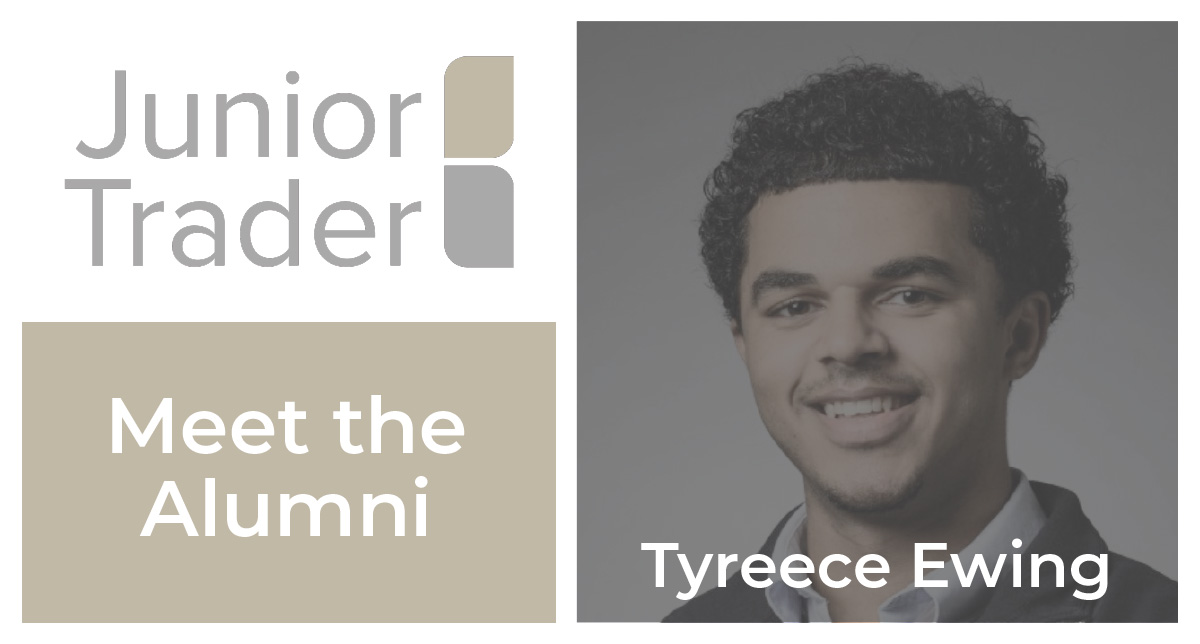
In the first of our Meet the Alumni blog series there is no better place to start than with Tyreece.
When people ask what separates Junior Trader from other student trading simulators, the easy answer is often assumed to be technical – platform design, rules, or structure. A Head of Sixth Form recently challenged me on that assumption.
The real answer is Tyreece Ewing.
Not the lectures, the platform, rules or the final leaderboard.
Tyreece.
He was one of the first students to come through Junior Trader after it became a non-profit. What matters about his journey is not just where he is heading, but how early he learned to take decisions seriously, and in the right order.
From the outset, he stood out not through bravado or certainty, but through how he approached learning. Curious, polite, and reflective, he absorbed feedback without rushing to perform. That combination is rare, and it compounds.
So, when we were (maybe deliberately, I don’t know for sure) placed next to each other at a school benefactor lunch after he had completed Junior Trader, the conversation deepened, the mentorship became real, and we became friends. This was a few years ago, and I recently formally interviewed him after he landed his graduate analyst role. When I asked him what he would title his book, he replied: ‘Gorton to Marylebone’. He is proud of his family and his background.
This interview reflects time spent one-to-one with Tyreece in January 2026, as he approached the end of his university journey, moved through recruitment processes, and into a specialised graduate role in the City.
Junior Trader did not hand him the keys to the City. What it did give him was something far more useful at seventeen: a sense of direction and a framework for judgment.
Unlike most trading simulators, Junior Trader does not drop students into the entire market and ask them to guess or draw lines on charts. It deliberately narrows the field. Food. Fashion. Online businesses. Sectors that students already understand because they live with them. For Tyreece, this mattered. It meant he could reason about companies rather than speculate. Learning accelerated. Confidence was earned rather than borrowed.
As the competition developed, complexity increased. Oil and currency markets entered the picture. Portfolio balance began to matter, and risk became visible rather than theoretical. This was not about chasing returns. It was about understanding how decisions interact, and how mistakes reveal themselves over time.
That grounding proved important beyond the competition. As Tyreece began applying for summer roles, he encountered a graduate recruitment system that had changed since I experienced it in the 1990s, but not necessarily for the better. Artificial intelligence now records interviews, reviews keywords, and filters candidates at industrial scale. The process saves firms money, but it wastes the time of those applying, and good people can get lost. Tyreece saw this clearly, and thrived at interview stage to intern with Deloitte. Junior Trader, he says, helped.
Now, he is heading into a London analyst role working with closed-ended family funds (illiquid structures where client trust operates at the highest level) and plans to begin his CFA as soon as possible. He already knows that one day he would like to run his own fund. He speaks about that ambition calmly and without entitlement.
One of the clearest shifts in his approach to company research, is separating noise from profit and that is a good foundation for the CFA. Stay close to a business long enough, and reality has a way of asserting itself.
Outside Junior Trader, Tyreece also completed the 10,000 Black Interns scheme. Rigorous and merit-based, it reinforced the same lessons: start early, show consistency, and let progression speak for itself.
His family are proud of the path he is on. When I ask about his starting package, there is no bragging. Just gratitude. He is open about wanting to give back one day, in some form, and about believing that broader perspectives lead to better decisions and more resilient outcomes. I’ll hopefully hold him to that.
Tyreece comes from a family with strong values and a clear work ethic. His brother is pursuing success through sport, on a different trajectory but with the same mindset: discipline, patience, and long-term thinking. I’d back either of them to take a penalty kick in a final.
This is why Junior Trader works.
Not because it simulates markets, but because it develops people early enough for it to matter.
So when schools ask what makes Junior Trader different, the answer is not software or simulation.
It is people like Tyreece.
#tradesafe
(If you have taken part in Junior Trader, and would like to share your experience please email to discuss a possible interview)